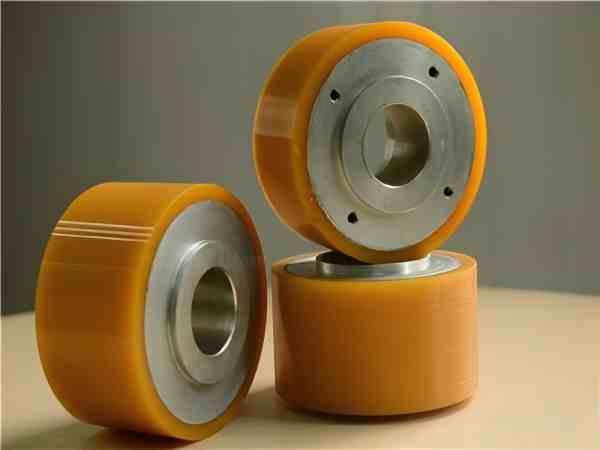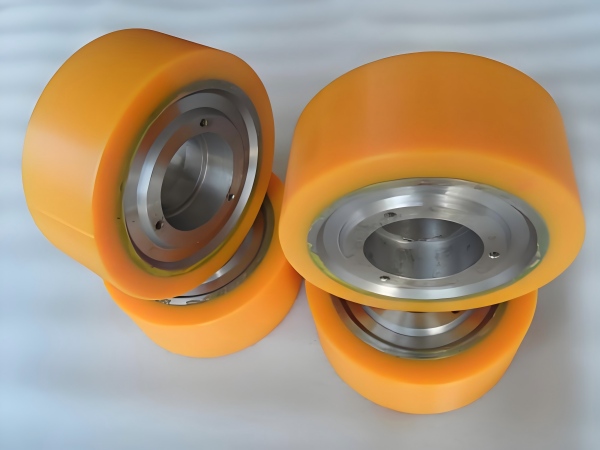


Quick answer: If your AGV or AMR carries heavy loads, runs long shifts, or operates at high speed and you want the longest possible service life, choose Vulkollan wheels. If your fleet is light- to medium-duty, indoor, and budget-sensitive, standard polyurethane (PU) wheels give the best value. Both materials are polyurethane elastomers, but Vulkollan is a premium cast grade that typically delivers 2–4× the wear life under load.
1. What Is Vulkollan?
Vulkollan is a high-performance cast polyurethane elastomer originally developed by Bayer and now a registered trademark of Covestro. It is produced from NDI-based (naphthalene diisocyanate) prepolymers, which create an exceptionally dense, elastic molecular structure. In AGV wheels, Vulkollan is cast directly onto a metal core (steel or aluminum) to form a single, void-free tread.
The result is a wheel that pairs rubber-like elasticity with a near-plastic load rating. That combination is why Vulkollan dominates applications such as ASRS high-bay storage, heavy forklift AGVs, and 24/7 automated transport lines where downtime from wheel wear is expensive.
2. What Is Polyurethane (PU) in AGV Wheels?
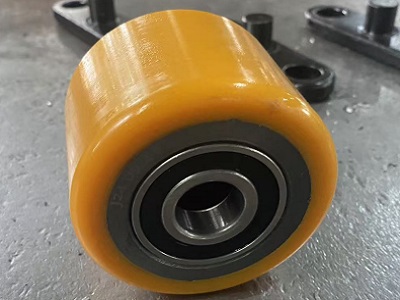
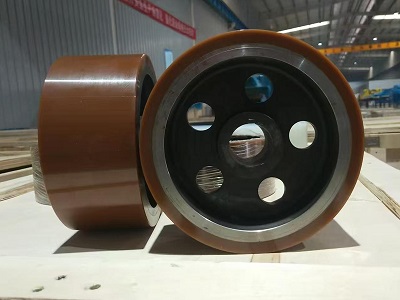
"Polyurethane wheels" is the broader category. Most AGV PU wheels are also cast elastomers (MDI- or TDI-based), while lower-cost versions may be injection-molded. They span a wide hardness and formulation range and are the default choice for general material-handling fleets, light AMRs, and applications where floor protection and low noise matter more than maximum load.
Standard PU can be tuned for anti-static properties, non-marking treads, and specific temperature ranges, which makes it highly versatile across cleanroom, semiconductor, food, and warehouse environments.
3. Vulkollan vs Polyurethane: Side-by-Side
Parameter | Vulkollan (cast PU) | Standard PU (cast/injection) |
Base chemistry | NDI-based cast elastomer (Covestro) | MDI / TDI-based cast or molded PU |
Hardness | 90–95 Shore A (≈60–70 Shore D) | 80–95 Shore A |
Tensile strength | 40–65 MPa | 20–45 MPa |
Tear strength | 80–120 N/mm | 40–90 N/mm |
Rebound resilience | 40–60% | 30–55% |
Abrasion loss (DIN 53516) | 30–60 mm³ | 60–120 mm³ |
Max continuous temp | ~80 °C (peak 100 °C) | ~60–70 °C (peak 80 °C) |
Min temp | ~ -20 °C | ~ -20 °C |
Load capacity | High (higher contact-pressure tolerance) | Medium |
Rolling resistance | Low | Low–Medium |
Relative service life | 2–4× standard PU under load | Baseline |
Relative cost | 2–3× | 1× |
*The above table shows typical parameter ranges, and actual values depend on the formula, wheel diameter, and wheel core structure; refer to the KUNFENG technical specification before placing an order.
4. Parameter Deep Dive
Hardness (Shore A) — Vulkollan typically runs 90–95 Shore A (about 60–70 Shore D); Standard PU spans 80–95 Shore A.
Load Capacity & Contact Pressure — Vulkollan tolerates higher contact pressure before permanent deformation; for 1 t+ payloads this margin is often decisive.
Abrasion Resistance & Service Life — DIN 53516: Vulkollan 30–60 mm³ vs PU 60–120 mm³ → 2–4× longer life.
Temperature Range — Vulkollan ~80 °C continuous (peak 100 °C); PU ~60–70 °C. Both lose elasticity near -20 °C.
Rolling Resistance, Energy & Noise — Both low-resistance; Vulkollan returns more energy, helps battery range on 3-shift AMRs.
Chemical & Oil Resistance — PU beats rubber; Vulkollan matches/exceeds standard PU.
Cost — Vulkollan 2–3× PU; payback via extended life and fewer stoppages on high-utilization lines.
5. How to Choose by Application
ASRS / high-bay / heavy forklift AGV → Vulkollan
Semiconductor / cleanroom → anti-static PU
Light pallet AMR / indoor handling → standard PU
3-shift / high-speed → Vulkollan
6. KUNFENG Vulkollan & PU Wheel Range
Vulkollan load wheels for AGVs → Vulkollan Load Wheels for Automated Guided Vehicles (AGVs)
Heavy-duty PU wheels for forklift AGV → Heavy Duty Polyurethane Wheels for Forklift AGV
PU load wheel for pallet-handling AMR → PU Load Wheel for Pallet Handling AMR
Polyurethane drive wheel for AGV robots → Polyurethane Drive Wheel for AGV Robots
Anti-static aluminum-core wheels → Anti-static Aluminum Core Wheels for AGV
7. Frequently Asked Questions
Q: Is Vulkollan the same as polyurethane?
A: Vulkollan is a premium brand of cast polyurethane (NDI-based, Covestro). All Vulkollan is polyurethane, but not all polyurethane is Vulkollan.
Q: Can Vulkollan wheels run on epoxy or coated floors?
A: Yes — non-marking at normal loads; pair with correct hardness to avoid impression marks under sustained heavy load.
Q: What hardness should I specify?
A: Heavy AGVs 90–95 Shore A Vulkollan; light indoor AMRs 80–90 Shore A PU.
Q: How much longer does Vulkollan last?
A: Typically 2–4× standard PU under comparable load (DIN 53516).
Q: Are Vulkollan wheels worth the higher cost?
A: For high-utilization/heavy/24-7 fleets — yes; for light occasional use, standard PU is better value.
Q: Does KUNFENG supply both materials?
A: Yes — across drive, load, and anti-static ranges.
8. Talk to KUNFENG
Not sure which material fits your AGV model, payload, and floor? KUNFENG's engineering team will recommend Vulkollan or polyurethane spec based on your duty cycle and budget.
→ Request a quote / technical datasheet: Contact AGV Wheels Manufacturer - KUNFENG
→ Explore the full AGV wheel catalog: Professional AGV Wheel Solutions - KUNFENG