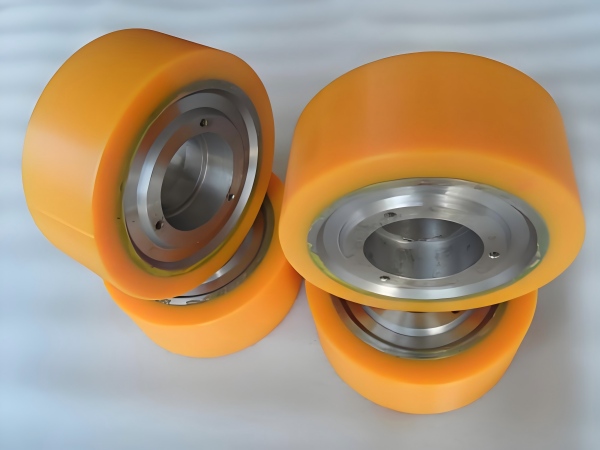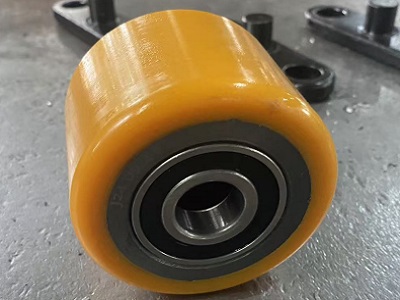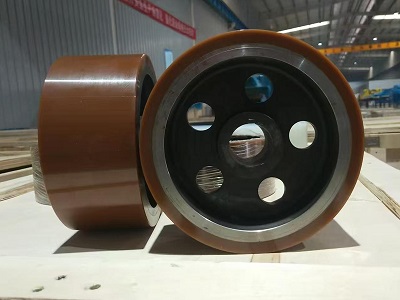


An anti-static AGV wheel is built so electrostatic charge travels safely to ground instead of building up and discharging into sensitive parts. KUNFENG's version pairs an aluminum wheel core with a conductive polyurethane tread: the carbon-loaded PU gives a controlled resistance path, and the aluminum core carries that path rigidly into the AGV chassis. In semiconductor fabs cleanrooms, where a single discharge can damage a wafer or ignite a solvent vapor, that path is part of the facility's ESD control program.
Why the Aluminum Core, Not Just a Conductive Tread
A conductive tread alone is not enough — the charge needs a stable, low-resistance route through the whole wheel to the axle and frame. Aluminum gives three things steel cannot match here: it is light enough to keep the AGV's unsprung mass down, it holds its shape under load so the tread contact stays even, and it forms a clean conductive bridge from tread to bearing seat. KUNFENG anodizes the core on request for corrosion resistance in wash-down lines.
Specification Window
Resistance is stated per ESD Association standard ESD S7.1 and IEC 61340. The values below are the typical window for KUNFENG conductive PU on aluminum core.
Parameter | Typical value (conductive PU / aluminum core) |
Core material | Aluminum alloy (anodized optional) |
Tread | Conductive PU, carbon-loaded |
Surface resistance | 10^4 – 10^9 Ω (ESD S7.1) |
Volume resistivity | 10^3 – 10^8 Ω·cm |
Static decay | < 2 s (FTMS 101 method) |
Hardness | 85–95 Shore A |
Tensile strength | 30–50 MPa |
Tear strength | 60–100 N/mm |
Operating temperature | -20 °C to +80 °C |
Cleanroom class | ISO 6–8 compatible (low particulation tread) |
Load class | Medium–heavy |
*Note: resistance range is tuned per order. Confirm the target band with your ESD engineer before release.
How the Charge Actually Reaches Ground
Carbon black in the PU forms a continuous conductive network. When the wheel rolls, charge generated at the contact patch flows through that network into the aluminum core, through the bearing and axle, and into the AGV frame, which is bonded to the facility ground. The wheel is one link in a grounded chain — it only works if the rest of the chain (frame, cable, floor grid) is also ESD-controlled.
Where These Wheels Are Specified
● Semiconductor fabs and SMT lines handling wafers and bare boards.
● Pharmaceutical and medical-device cleanrooms with solvent processes.
● Lithium battery and electronics assembly where ESD budgets are tight.
● Metrology labs where static attracts particulates onto optics.
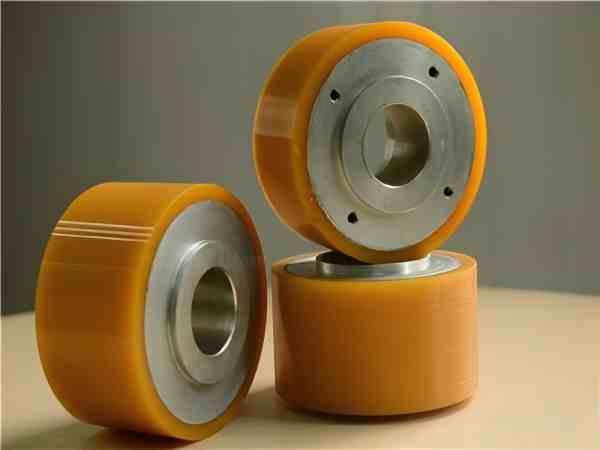
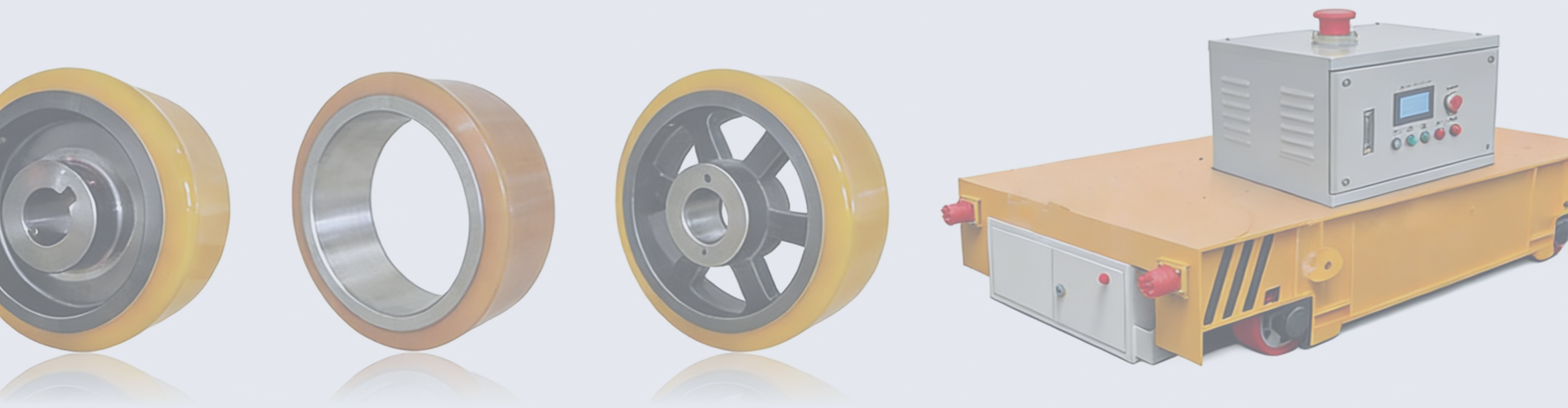
KUNFENG Anti-Static Wheel Range
Frequently Asked Questions
Q: What surface resistance counts as ESD-safe?
A: For this application KUNFENG targets 10^4–10^9 Ω point-to-point, aligned with ESD S7.1 for static-control surfaces.
Q: Aluminum core or steel core for ESD?
A: Both conduct, but aluminum is lighter and holds tread geometry better under load. KUNFENG uses aluminum as the default for AGV drive wheels.
Q: Do anti-static wheels also need a cleanroom rating?
A: In semiconductor and pharma use, yes — the tread must also shed few particles. KUNFENG selects low-particulation PU for those grades.
Q: Will the conductive PU mark floors?
A: Conductive PU can be formulated non-marking as well. Tell KUNFENG if you need both ESD and floor protection in one wheel.
Q: How is the wheel verified anti-static?
A: KUNFENG measures surface and volume resistance per ESD S7.1 / IEC 61340 and supplies the report with the batch.
Q: Can KUNFENG tune the resistance range?
A: Yes. The carbon loading is adjusted to hit your specified band; we confirm with a test report before volume shipment.
Contact Us
If your AGVs run in a semiconductor or pharma cleanroom, send KUNFENG your target resistance band, cleanroom class, and payload. We will specify the conductive PU grade and aluminum core, and supply an ESD test report with the order.
Request a quote / ESD test report: https://www.agv-wheels.com/contact
Browse the AGV wheel catalog: https://www.agv-wheels.com/products